Inflammation has emerged as one of the most important concepts in modern medicine. It plays a protective role in fighting infections and repairing tissue damage, yet persistent inflammation can also contribute to chronic illnesses such as rheumatoid arthritis and cardiovascular disease. As a result, blood tests that measure inflammation are increasingly being included in diagnostic workups and preventive health packages.
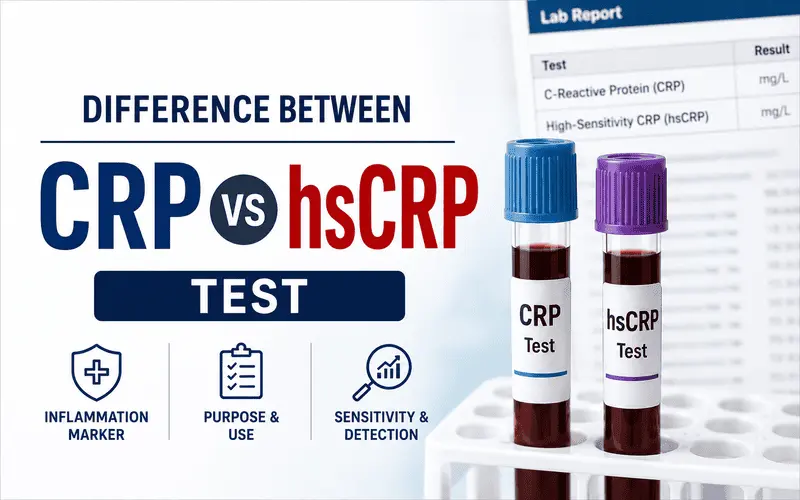
Among these, the C-reactive protein (CRP) test and the high-sensitivity C-reactive protein (hsCRP) test are commonly misunderstood. Since both measure the same protein, many individuals assume they are interchangeable. However, clinicians use these tests to answer very different questions.
A standard CRP test helps determine whether significant inflammation is occurring in the body at present. The hsCRP test, in contrast, identifies subtle inflammatory changes that may indicate an increased risk of future cardiovascular events. Understanding this distinction is essential because interpreting the wrong test in the wrong clinical setting can lead to unnecessary anxiety, false reassurance, or inappropriate conclusions.
CRP and hsCRP Measure the Same Protein, but Tell Different Stories
Both CRP and hsCRP assess levels of C-reactive protein, an inflammatory marker produced by the liver in response to signals from the immune system. The difference lies not in what they measure, but in how sensitively they measure it.
The standard CRP test is designed to detect moderate to marked elevations in inflammation. It is particularly useful when doctors suspect infections, inflammatory diseases, or tissue injury.
The hsCRP test uses more sensitive laboratory techniques capable of detecting much smaller changes in CRP levels. These minor elevations often occur in chronic low-grade inflammation, especially within blood vessels, and have been associated with future cardiovascular risk.
One of the biggest misconceptions surrounding these tests is the belief that hsCRP is simply a "better version" of CRP. In reality, neither test is superior. Their usefulness depends entirely on the clinical context.
Why a Standard CRP Test Is Often Ordered
In clinical practice, CRP functions as an alarm signal rather than a diagnosis.
When the body encounters bacterial infections, autoimmune flares, or tissue damage, inflammatory pathways stimulate the liver to produce larger quantities of C-reactive protein. Within hours, blood levels can rise substantially.
This makes CRP particularly valuable when physicians are trying to answer a straightforward question:
Is there significant inflammation occurring in the body right now?
For example, elevated CRP levels may support the suspicion of an active bacterial infection in a person with persistent fever. Similarly, in individuals with rheumatoid arthritis, serial CRP measurements may help assess whether disease activity is improving or worsening.
However, CRP has limitations.
An elevated value cannot identify the source of inflammation. Post-surgical recovery, inflammatory bowel disease, pneumonia, autoimmune conditions, and even major trauma can all produce similar elevations.
This is why CRP should never be interpreted in isolation. The result gains meaning only when combined with symptoms, examination findings, and other investigations.
Why hsCRP Became Important in Cardiology
For decades, cardiovascular risk assessment focused largely on cholesterol levels, smoking history, diabetes, and blood pressure. While these remain important predictors, researchers recognized that inflammation also contributes significantly to the development of atherosclerosis.
Atherosclerosis is no longer viewed simply as cholesterol accumulating inside arteries. It is increasingly understood as an inflammatory process involving immune activation within blood vessel walls.
The hsCRP test emerged from this evolving understanding.
Unlike standard CRP, hsCRP can identify subtle inflammation that would otherwise go undetected. These low-grade elevations may indicate an environment within the arteries that favors plaque instability and future cardiovascular events.
This explains why an individual with apparently normal cholesterol levels may still have elevated cardiovascular risk if hsCRP levels remain persistently high.
Importantly, hsCRP does not diagnose heart disease. Instead, it refines risk assessment and adds another dimension to preventive decision-making.
The Clinical Scenario That Explains the Difference Best
Consider two middle-aged individuals with similar cholesterol levels, blood pressure readings, and body mass indices. Neither has diabetes, and neither has a history of smoking.
Traditional risk calculators might classify both individuals similarly.
However, one individual's hsCRP level measures below 1 mg/L, while the other's consistently exceeds 3 mg/L.
Evidence suggests that the latter individual may have a greater burden of vascular inflammation and potentially higher long-term cardiovascular risk. In such circumstances, clinicians may place greater emphasis on aggressive lifestyle interventions and closer monitoring.
Now consider a different scenario.
An individual presenting with high fever, severe fatigue, and suspected pneumonia would derive little benefit from hsCRP testing. A standard CRP measurement would be more appropriate because the immediate concern is identifying active inflammation rather than predicting future heart disease.
These examples illustrate why choosing the correct test matters.
CRP vs hsCRP: Key Differences at a Glance
| Feature | CRP Test | hsCRP Test |
|---|---|---|
| Full Form | C-Reactive Protein | High-Sensitivity C-Reactive Protein |
| Detects | Moderate to severe inflammation | Low-grade inflammation |
| Primary Purpose | Evaluate active inflammatory processes | Assess cardiovascular risk |
| Common Clinical Use | Infections, autoimmune diseases, inflammatory disorders | Preventive cardiology |
| Sensitivity | Standard | Highly sensitive |
| Interpretation Focus | Current health status | Future cardiovascular risk |
Although this comparison simplifies the distinction, interpretation still depends heavily on the broader clinical picture.
Understanding the Normal Ranges
Laboratory values are often the source of confusion because the same number may have different implications depending on the test performed.
For a standard CRP test, levels below 10 mg/L are generally considered within normal limits. Values above this threshold suggest the presence of inflammation and warrant further evaluation.
The hsCRP test is interpreted differently because it focuses on cardiovascular risk categories.
| hsCRP Level | Cardiovascular Interpretation |
|---|---|
| Less than 1 mg/L | Lower cardiovascular risk |
| 1 to 3 mg/L | Average cardiovascular risk |
| More than 3 mg/L | Higher cardiovascular risk |
A critical nuance often overlooked is that hsCRP should not be measured during acute illness. Even a recent viral infection can temporarily elevate results and overestimate cardiovascular risk.
If hsCRP exceeds 10 mg/L, many clinicians recommend repeating the test once the acute inflammatory episode has resolved.
One of the Biggest Misconceptions About CRP
Perhaps the most common misunderstanding is assuming that a high CRP automatically means infection.
From a clinical perspective, CRP should be viewed as a marker of inflammation rather than a marker of infection alone.
A patient recovering from abdominal surgery, another experiencing a flare of rheumatoid arthritis, and a third hospitalized with bacterial pneumonia may all demonstrate elevated CRP levels.
The number itself cannot distinguish among these possibilities.
Similarly, a mildly elevated hsCRP does not guarantee that a heart attack will occur. It merely indicates that low-grade inflammation may be contributing to an individual's overall cardiovascular risk profile.
Understanding these limitations prevents both unnecessary panic and false reassurance.
Can CRP and hsCRP Levels Be Reduced Naturally?
The answer depends largely on why the levels are elevated.
When CRP rises because of infection, treatment must address the underlying illness. Similarly, autoimmune diseases often require disease-specific therapies.
Low-grade inflammation associated with elevated hsCRP presents a different opportunity.
Studies suggest that lifestyle interventions capable of improving metabolic health may also reduce inflammatory burden. Weight reduction, regular physical activity, smoking cessation, and dietary patterns emphasizing fruits, vegetables, legumes, whole grains, and healthy fats have all been associated with lower hsCRP levels.
Adequate sleep and stress management may further support healthier inflammatory regulation.
The focus, however, should remain on improving overall health rather than pursuing a laboratory target in isolation.
Which Test Is More Appropriate?
The answer depends entirely on the question being asked.
If clinicians are investigating unexplained fever, suspected infection, inflammatory disease activity, or tissue injury, a standard CRP test is generally the preferred choice.
If the goal is to refine cardiovascular risk assessment in a clinically stable individual without active illness, hsCRP testing may provide additional insights beyond traditional risk factors.
Understanding this distinction helps ensure that laboratory investigations are used thoughtfully rather than reflexively.
The Bottom Line
CRP and hsCRP may measure the same protein, but they reveal different aspects of health.
The CRP test provides insight into significant inflammation occurring in the present and is commonly used in the evaluation of infections and inflammatory disorders. The hsCRP test detects subtle inflammatory activity that may help identify individuals at higher risk of future cardiovascular events.
Neither test should be interpreted independently of clinical context. Their greatest value lies not in the numbers themselves, but in how those numbers influence diagnosis, risk assessment, and medical decision-making.
For both clinicians and patients, understanding why a particular test was ordered is often more important than simply knowing whether the result is normal or abnormal.
References
- American Heart Association. C-Reactive Protein Test
https://www.heart.org/en/health-topics/heart-attack/diagnosing-a-heart-attack/c-reactive-protein-crp-test - Mayo Clinic. C-Reactive Protein Test
https://www.mayoclinic.org/tests-procedures/c-reactive-protein-test/about/pac-20385228 - Cleveland Clinic. C-Reactive Protein Test
https://my.clevelandclinic.org/health/diagnostics/23056-c-reactive-protein-crp-test - National Center for Biotechnology Information. High-Sensitivity C-Reactive Protein and Cardiovascular Disease
https://www.ncbi.nlm.nih.gov/pmc/articles/PMC2215387/ - MedlinePlus. C-Reactive Protein Test
https://medlineplus.gov/lab-tests/c-reactive-protein-crp-test/