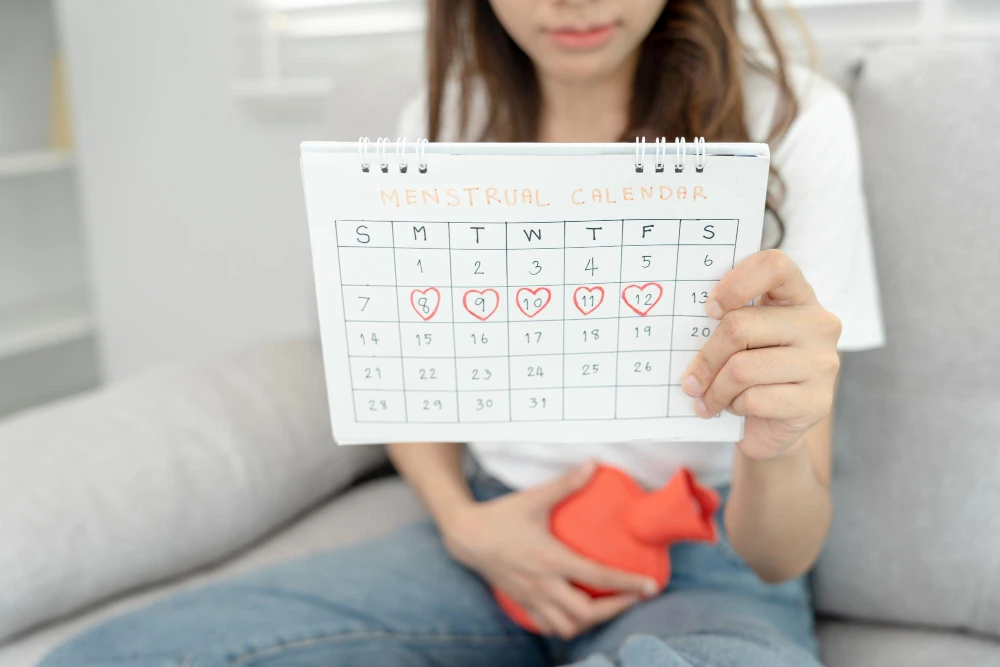
Understanding your menstrual cycle can help you identify when you are most likely to get pregnant and when pregnancy is less likely. Whether you are planning a pregnancy or trying to understand your fertile days, knowing how ovulation works can make your cycle easier to track.
A Safe Days Calculator estimates your period days, fertile window, likely ovulation day and lower-risk days using your menstrual cycle information. It can help you understand your cycle, but it is important to remember that there are no completely guaranteed safe days for unprotected sex.
In this guide, we explain how to calculate safe days, understand fertile days, estimate ovulation and use the free SecondMedic Safe Days Calculator.
What Are Safe Days in a Menstrual Cycle?
Safe days are commonly described as the days when the chance of pregnancy is lower because they fall outside the estimated fertile window.
To understand safe days, you first need to understand three stages of the menstrual cycle:
- Menstrual phase: The first day of menstrual bleeding marks the beginning of a new cycle.
- Follicular phase: The body prepares an egg for release.
- Ovulation: An ovary releases an egg, which may be fertilised if sperm are present.
- Luteal phase: The body prepares for a possible pregnancy. If pregnancy does not occur, the next menstrual period usually begins.
The timing of these stages can vary between people and from one cycle to another.
For example, in a regular 28-day cycle, ovulation is often estimated around day 14. However, it does not happen on exactly the same day for everyone.
Important: Safe days are estimates, not a reliable guarantee against pregnancy. If you want to avoid pregnancy, discuss effective contraception options with a healthcare professional.
What Is a Fertile Window?
The fertile window is the period during which sexual intercourse can result in pregnancy.
It generally includes:
- The five days before ovulation.
- The day of ovulation.
This is because sperm can survive inside the reproductive tract for up to five days under suitable conditions, while an egg can usually be fertilised for approximately 12–24 hours after ovulation.
For example, if ovulation occurs around day 14 of a 28-day cycle, the estimated fertile window is approximately day 9 to day 14. Calendar-based methods may use a wider window to account for variation in ovulation timing.
The chance of conception is generally highest in the days leading up to ovulation and around ovulation itself.
How to Calculate Safe Days?
The calendar or rhythm method estimates fertile days using the length of previous menstrual cycles.
For this method, you need to record your menstrual cycle lengths over several months.
The first day of menstrual bleeding is counted as Day 1.
If your cycles vary, the calculator uses your shortest and longest recorded cycles to estimate a wider fertile window.
The commonly used calculation is:
- First fertile day = Shortest cycle length − 18
- Last fertile day = Longest cycle length − 11
Days outside this estimated window are marked as lower-risk days.
Example: Calculating Safe Days for a 28-Day Cycle
Suppose your menstrual cycle is consistently 28 days long.
- Shortest cycle: 28 days.
- Longest cycle: 28 days.
- First fertile day: 28 − 18 = Day 10.
- Last fertile day: 28 − 11 = Day 17.
Your estimated calendar is:
| Cycle days | Estimated phase |
|---|---|
| Day 1–5 | Usually menstrual days |
| Day 6–9 | Lower-risk days |
| Day 10–17 | Estimated fertile window |
| Around Day 14 | Likely ovulation |
| Day 18–28 | Lower-risk days |
These dates are estimates, not a guarantee that pregnancy cannot occur outside the fertile window.
Safe Days According to Different Cycle Lengths
The estimated fertile window changes depending on your menstrual cycle length.
The following table follows the calendar calculation used by the SecondMedic Safe Days Calculator.
| Cycle length | Estimated fertile days | Likely ovulation | Lower-risk days |
|---|---|---|---|
| 24 days | Day 6–13 | Around Day 10 | Day 1–5 and 14–24 |
| 25 days | Day 7–14 | Around Day 11 | Day 1–6 and 15–25 |
| 26 days | Day 8–15 | Around Day 12 | Day 1–7 and 16–26 |
| 27 days | Day 9–16 | Around Day 13 | Day 1–8 and 17–27 |
| 28 days | Day 10–17 | Around Day 14 | Day 1–9 and 18–28 |
| 29 days | Day 11–18 | Around Day 15 | Day 1–10 and 19–29 |
| 30 days | Day 12–19 | Around Day 16 | Day 1–11 and 20–30 |
| 31 days | Day 13–20 | Around Day 17 | Day 1–12 and 21–31 |
| 32 days | Day 14–21 | Around Day 18 | Day 1–13 and 22–32 |
| 33 days | Day 15–22 | Around Day 19 | Day 1–14 and 23–33 |
| 34 days | Day 16–23 | Around Day 20 | Day 1–15 and 24–34 |
| 35 days | Day 17–24 | Around Day 21 | Day 1–16 and 25–35 |
This is an approximate calendar-based estimate. It does not confirm the actual date of ovulation.
What Is Ovulation and How Can You Identify It?
Ovulation is the process in which an ovary releases an egg.
In many menstrual cycles, ovulation occurs approximately 14 days before the next period begins. It is not necessarily 14 days after the previous period starts.
Some people notice changes around ovulation, including:
- Clear, slippery vaginal discharge that may stretch between the fingers.
- Mild pain or discomfort on one side of the lower abdomen.
- Increased sexual desire.
- Slight changes in basal body temperature after ovulation.
- Breast tenderness in some individuals.
These signs can help you understand your cycle, but they do not confirm ovulation on their own.
Ovulation predictor kits that measure luteinising hormone (LH) can also help identify when ovulation may be approaching.
How to Use the SecondMedic Safe Days Calculator
You can estimate your safe days, fertile window and likely ovulation date using the free SecondMedic tool.
Try it here: SecondMedic Safe Days Calculator
Follow these steps:
Step 1: Enter the First Day of Your Last Period
Select the date your most recent menstrual period started. This date is counted as Day 1 of your cycle.
Step 2: Enter Your Usual Cycle Length
Enter the number of days between the first day of one period and the day before your next period begins.
For example, if your period starts every 28 days, enter 28.
Step 3: Enter Your Period Duration
Add how many days your menstrual bleeding usually lasts.
Step 4: Select Whether Your Cycle Varies
If your menstrual cycle does not have the same length every month, select the option indicating that your cycle length varies.
Enter your shortest and longest cycle lengths, preferably using records from at least the previous six months.
Step 5: Calculate Your Safe Days
Tap the Calculate button to view your estimated calendar.
The calculator displays:
- Period days.
- Estimated fertile window.
- Likely ovulation day.
- Lower-risk days.
It provides estimates for the next three cycles. The calendar uses different colours to distinguish period days, fertile days, likely ovulation and lower-risk days.
The tool is free to use, does not require sign-up and states that your entered numbers stay on your device.
Is It Safe to Have Sex During Safe Days Without Protection?
This is one of the most common questions about menstrual cycle tracking.
The answer is that pregnancy is less likely on estimated lower-risk days, but it is still possible.
There are several reasons:
- Ovulation can happen earlier or later than expected.
- Menstrual cycles may change from month to month.
- Sperm can survive for several days inside the reproductive tract.
- Stress, illness and hormonal changes can affect ovulation timing.
- Calendar calculations cannot confirm exactly when an egg is released.
The Standard Days Method is a specific fertility-awareness method intended for people whose cycles are consistently 26–32 days long. It identifies days 8–19 as days to avoid unprotected intercourse. It should not be confused with a personalised calendar estimate for every cycle length.
If avoiding pregnancy is important, consider a more reliable contraceptive method after discussing your options with a qualified healthcare professional.
Condoms also help reduce the risk of sexually transmitted infections (STIs). Calendar tracking does not provide STI protection.
Can You Use a Safe Days Calculator to Plan Pregnancy?
Yes. A safe days calculator can also help people who are trying to conceive by identifying the estimated fertile window.
If you are planning a pregnancy:
- Record your menstrual cycle dates.
- Estimate your likely ovulation day.
- Identify the fertile window.
- Consider having intercourse every day or every other day during the fertile window.
- Track changes in cervical mucus or use an ovulation predictor kit if helpful.
The two or three days leading up to ovulation and the day of ovulation are particularly useful times to identify when conception is most likely.
If you have been trying to conceive for 12 months without success, or for six months if you are 35 or older, consider consulting a gynaecologist. Seek advice sooner if you have very irregular periods or a known reproductive health condition.
When Is a Safe Days Calculator Less Reliable?
Calendar-based predictions are less reliable when ovulation timing is difficult to estimate.
This can happen in situations such as:
- Irregular menstrual cycles.
- Polycystic ovary syndrome (PCOS).
- Thyroid-related hormonal problems.
- Breastfeeding or the period after childbirth.
- Recently stopping hormonal contraception.
- Perimenopause.
- Significant stress or illness.
If your periods are irregular, the calculator can use your shortest and longest cycles to widen the estimated fertile window. However, it cannot reliably predict ovulation when cycle patterns change substantially.
A gynaecologist can help evaluate irregular periods and discuss appropriate contraception or fertility guidance.
Understand Your Menstrual Cycle with SecondMedic
Understanding your menstrual cycle can help you recognise your fertile window, estimate ovulation and make more informed reproductive health decisions.
The free SecondMedic Safe Days Calculator allows you to enter your last period date and cycle length to estimate your period days, fertile window, likely ovulation and lower-risk days.
If you are planning a pregnancy, experiencing irregular periods or need help choosing contraception, consider consulting a gynaecologist.
You can also explore SecondMedic Women's Health Tests, including:
- PCOS Mini – 51 Parameters
- Women Basic Profile with UTSH – 73 Parameters
- Pre-Pregnancy Profile – 52 Parameters
These packages include different investigations and are not required by everyone. A doctor can help decide whether any tests are appropriate based on your symptoms and medical history.
Explore all SecondMedic Health Calculators for more tools to understand your health.
Medical disclaimer: This article is for educational purposes only. A safe days calculator cannot confirm ovulation, diagnose fertility problems or guarantee pregnancy prevention. Calendar-based methods do not protect against sexually transmitted infections. Consult a qualified healthcare professional for personalised reproductive health and contraception advice.